levelbox.ai: the options screener, and the risk, market and signal work under it
levelbox ranks cash-secured puts for retail traders; most of what bluebed built sits under the screener, in risk controls, a market backdrop read and signals of change.
What the screener shows
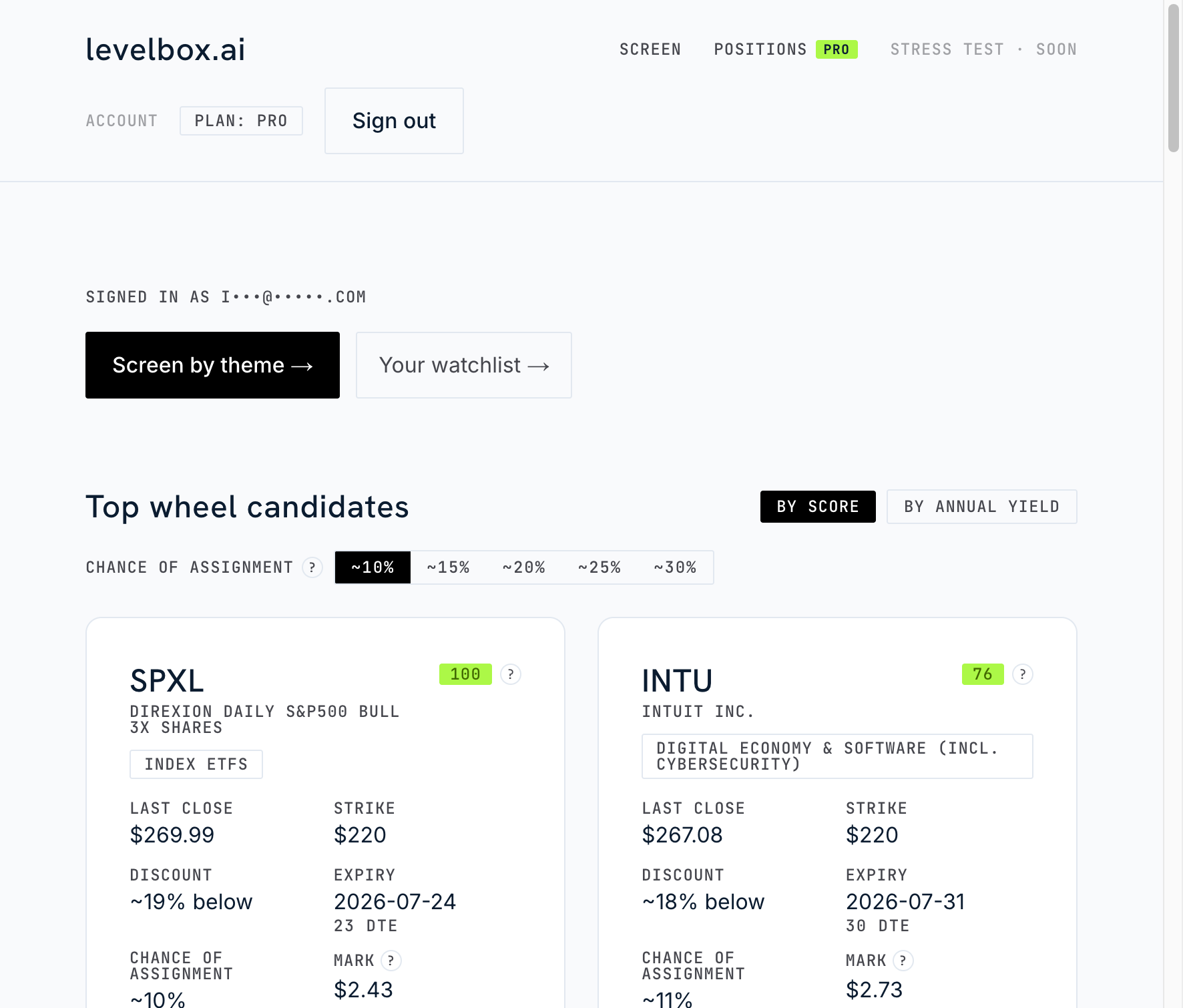
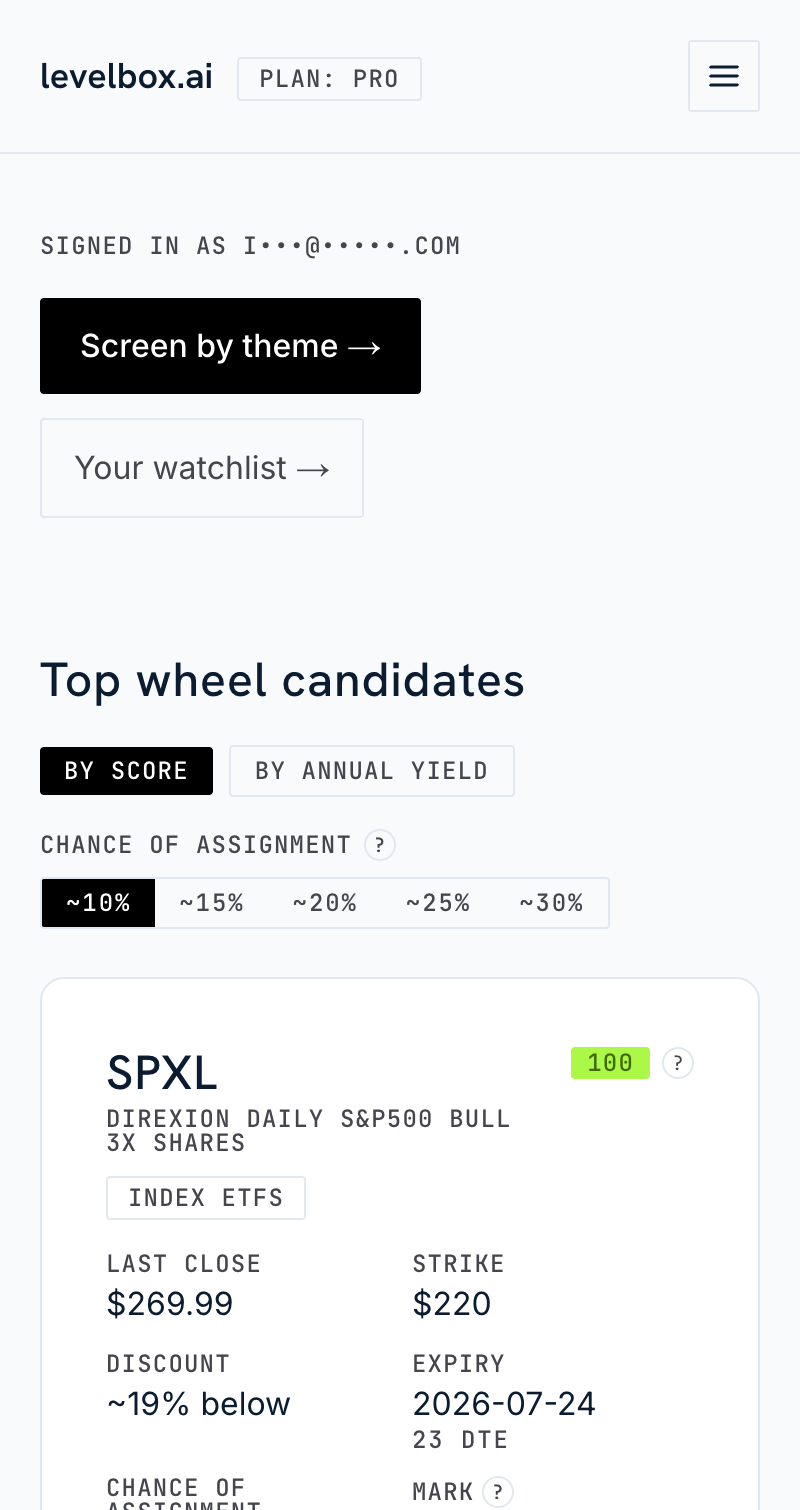
levelbox.ai is a web app for retail traders who sell options on US shares. The part users see first is a screener that ranks cash-secured puts and covered calls.
In a cash-secured put, the trader agrees to buy 100 shares of a company at a set price, called the strike, if the share price is below it on an agreed date, called the expiry. They keep the cash for those shares aside. In return, they receive a fee up front, called the premium, which they keep whatever happens. If the share price is below the strike at expiry, the trader is assigned: they must buy the shares at the strike, even if the market price is lower. A covered call is the same deal in reverse, on shares the trader already owns.
For each candidate, the screener shows the premium, the annualised yield, the breakeven price, the maximum loss, the 30-day implied volatility and the chance of assignment. It covers 399 stocks in 16 themes.
levelbox is analysis, not a broker. It holds no client money and places no orders; users place their own trades with their own broker. The product describes its output as educational, not investment advice. Accounts are free and need no card.
Most of the work sits under the screener, in three layers that decide what reaches the list and what a user is told about it: risk management, a read of the market backdrop, and signals that show when conditions are changing.
Risk management
Risk management is the largest of the three layers: seven parts decide what reaches the list and what downside a trader sees before committing.
Chance of assignment on every candidate. levelbox computes it with the Black-Scholes-Merton options model. It is the probability, implied by today's option prices, that the share price finishes below the strike at expiry. It is not levelbox's own forecast of the share price. Users can filter the list by it, from about 10% to about 30%.
Risk beside every signal. This is one of the project's written rules. It is why maximum loss and the chance of assignment sit next to the premium on every candidate, not on a separate page.
A gate before scoring. A stock is scored only if it is listed in the US, has listed options and passes a minimum financial standard. A stock that fails is not ranked, however large its premium.
A penalty for leveraged funds. Leveraged and inverse ETFs are funds built to move two or three times the market, or against it. Their options pay large premiums, so in July 2026 they took over the top of the list: the screener pictured on this page ranked a 3x leveraged S&P 500 ETF first. That was the wrong answer for this strategy. These funds lose value over time when the market swings, because they reset their leverage every day, so they are poor shares to be left holding if a put is assigned. levelbox now keeps a list of 34 leveraged and inverse ETFs and halves their premium score, and like every stock they must pass the eligibility gate before they are scored.
Quality carries the most weight. Each candidate's Wheel Score blends six lenses, each with a relative weight. Quality carries 0.40, from mechanical versions of Warren Buffett's and Bill Ackman's stock screens. Liquidity carries 0.20; premium, value and financial health carry 0.15 each; growth, from a Peter Lynch screen, carries 0.10. When data for a lens is missing, the score re-weights across the lenses that remain instead of counting the gap as zero. The score was calibrated against a universe of 324 stocks.
A portfolio stress test (in development). It applies a fall in US shares to every position at once, using each stock's measured sensitivity to a crash, and reports the modelled loss as a percentage of the account's net liquidation value. This is levelbox's own model, not a broker's margin figure.
A premium optimizer (in development). The user sets two limits: the largest loss they will accept in a market crash, and the largest dollar amount of shares they could be assigned. The optimizer then returns a plan in three phases: reduce risk, redeploy the freed capital, then add premium.
The market backdrop
In a broad sell-off, more shares fall below their strikes at the same time, so more positions are assigned together.
levelbox's landing page shows a market regime score from 0 to 100, in four states: risk-on at 66 and above, neutral from 50 to 66, cautious from 34 to 50, and risk-off below 34. It blends four inputs:
- Trend (0.30): the QQQ and SPY index funds against their 50-day and 200-day moving averages, and the slope of those averages.
- Breadth (0.25): measured across about 50 technology stocks, to show whether a move is broad or carried by a few names.
- Volatility (0.25): the VIX index of expected 30-day volatility against the three-month VIX. When the near-term figure rises above the longer one, the market is pricing more fear now than later.
- Macro (0.20): the US high-yield credit spread, from the Federal Reserve Bank of St. Louis (FRED series BAMLH0A0HYM2), and the 10-year US Treasury yield. A wider credit spread means lenders are charging riskier companies more.
AI assistants connected to levelbox can also fetch a rates snapshot: US interest rates and money supply from FRED.
For a put seller, a cautious or risk-off reading means the risks in the section above are more likely to arrive together: more positions could be assigned at once, and a crash would hit them all. A risk-on reading means the four inputs together point to calmer conditions. levelbox shows the state; the decision stays with the user.
Signals that show change
levelbox also tracks signals that show when conditions are shifting. levelbox does not claim that any of them forecasts prices.
A regime label that does not flicker. The regime label changes only when the score crosses a threshold by 3 points, or stays across it for two days. Without this rule, a score sitting near 50 would switch between neutral and cautious on a quiet day.
Implied volatility, ranked. IV30 is the average implied volatility of at-the-money options at the expiry nearest 30 days. IV rank places today's figure on a 0 to 100 scale against the stock's own history, and needs at least 20 stored readings of the stock's implied volatility. levelbox also flags when implied volatility is expanding or compressing, which changes how much premium a seller is paid.
Insider buying and selling. Company insiders report their trades to the US Securities and Exchange Commission (SEC) on Form 4. levelbox collects these every weekday at 10:00 UTC and calculates the net flow, buying minus selling.
Superinvestor holdings. Large US fund managers report their holdings to the SEC every quarter on Form 13F. levelbox tracks 17 of them, including Warren Buffett, Bill Ackman, Michael Burry, Carl Icahn, David Tepper and Seth Klarman. Each fund's SEC identifier was checked against the SEC's EDGAR database on 23 July 2026.
How bluebed built it
The architecture
levelbox runs as two applications on Vercel, in its Sydney region. A Python API built on FastAPI does the analysis. A Next.js web app, written in TypeScript, is what users see on desktop and phone. Supabase holds the Postgres database and user accounts, and Alembic migrations manage changes to the database schema. SEC filings come in through edgartools and option prices through yfinance; scheduled GitHub Actions jobs collect the data in the background.
The analysis engine
The options engine prices options with the Black-Scholes-Merton model, computes their sensitivities to price, time and volatility (the "Greeks"), and solves for implied volatility. Annualised yield is the option's mid price divided by the capital at risk, scaled to a year: mid price ÷ basis × 365 ÷ days to expiry. For a put the basis is the strike; for a covered call it is the share price. This lets a trader compare a 23-day option with a 30-day one on equal terms.
The guard rails
The Python engine has over 4,600 tests across 405 test files, and the web app has 175 test files. Before any change leaves a developer's machine, a pre-push check runs the tests, the ruff linter and the mypy type checker, so a change that breaks a calculation does not reach the live site.
levelbox was built with Claude Code, set up with three specialist agents (a quant analyst, a fundamental analyst and a market-data engineer) and 13 skills, such as options maths and fundamental analysis. The project's written rules, kept in its CLAUDE.md file, apply to every agent and every change:
- Never fabricate data. A figure on screen has to come from market or filing data.
- Report the risk beside any signal.
- Write in educational language, not advice.
An optional narrator using Google's Gemini 2.5 Flash model exists in the code but sits outside the public API. The figures users see are computed by the Python engine, not written by a language model.
What runs today
Live for users: the screener, the market regime read, superinvestor tracking, and an MCP server. MCP, the Model Context Protocol, is the standard that lets AI assistants such as Claude call outside tools; levelbox's server has 14 tools, free under fair use. levelbox.ai also has 43 published articles on the wheel, the Greeks, the market regime and 13F filings.
In development: the portfolio stress test and the premium optimizer, both planned for a Pro tier that has a waitlist and no price yet.
What this means for your project
levelbox shows the kind of product bluebed builds and runs: a data pipeline, a tested analysis engine, a web app, an interface for AI assistants, and written rules that stop it making up numbers or giving advice. If you need an analytical product built and kept running, book a meeting.
Built with
- Python 3.11+
- Language of the analysis engine and API, managed with uv.
- FastAPI 0.136.3
- The API that serves screener, regime and fund data to the web app.
- Pydantic 2.13.4
- Validates every request and response shape the API handles.
- SQLAlchemy 2.0.50
- Database access from Python, over asyncpg to Postgres.
- SciPy 1.17.1
- Statistics behind the Black-Scholes-Merton pricing and the implied-volatility solver.
- NumPy 2.4.6
- Numerical arrays for the options and scoring calculations.
- edgartools 5.43.0
- Reads SEC filings: 13F fund holdings and Form 4 insider trades.
- yfinance 1.4.1
- Default source of share and option prices.
- fastmcp 3.4.2
- Runs the MCP server that lets AI assistants query levelbox.
- Next.js 15.5.19
- The web app users see, on the App Router.
- React 18.3.1
- User interface components in the web app.
- TypeScript 5.9.3
- Language of the web app.
- Tailwind CSS 3.4.19
- Styling for the web app on desktop and phone.
- Supabase
- Hosted Postgres database and user sign-in.
- Vercel
- Hosts the API and the web app, in the Sydney region.
- GitHub Actions
- Runs the scheduled data-collection jobs.
- pytest 9.0.3
- Runs the 4,600-plus Python tests, alongside ruff and mypy in the pre-push check.
- Claude Code
- The coding agent used to build levelbox, with three specialist agents and 13 skills under the project's written rules.
Questions
What is levelbox.ai?
levelbox.ai is a web app that helps retail options traders choose cash-secured puts and covered calls on US shares. For each candidate it shows the premium, annualised yield, breakeven, maximum loss, implied volatility and chance of assignment. It is analysis, not a broker, and users place their own trades. bluebed, a Singapore studio, built levelbox and runs it.
How does levelbox avoid giving wrong numbers or financial advice?
levelbox has over 4,600 automated tests on its Python engine, and a pre-push check runs them with the ruff linter and mypy type checker before any change ships. Its written rules forbid fabricated data, require risk to be shown beside every signal, and keep all wording educational rather than advice.
Does levelbox use AI to produce its figures?
No. levelbox's figures are computed by its Python engine from market and SEC filing data. An optional Gemini 2.5 Flash narrator exists in the code but sits outside the public API. AI was used to build levelbox, through Claude Code, and AI assistants can query it through its MCP server.
How does levelbox manage risk for options sellers?
levelbox shows the chance of assignment and the maximum loss beside every candidate's premium, scores only US-listed optionable stocks that pass a financial floor, and halves the premium score of 34 leveraged and inverse ETFs. A portfolio stress test and a premium optimizer with crash and assignment limits are in development.
What market signals does levelbox track?
levelbox tracks a 0 to 100 market regime score built from trend, breadth, VIX term structure and macro data, plus implied volatility rank, insider Form 4 net flow and the 13F holdings of 17 superinvestor funds. These are signals of changing conditions, not price predictions.
Can bluebed build an analytical product like levelbox for my company?
Yes. bluebed builds and runs analytical software of the kind levelbox shows: a data pipeline, a tested calculation engine, a web app that works on desktop and phone, and an interface for AI assistants. Book a meeting at bluebed.ai to discuss your project.
If you want something like this made, book a consultation