AI software development in Singapore, built and then run for you
bluebed builds custom AI software, apps and internal tools for companies in Singapore and Malaysia. After launch, we keep running it, and your team uses it from one app.
Book a meeting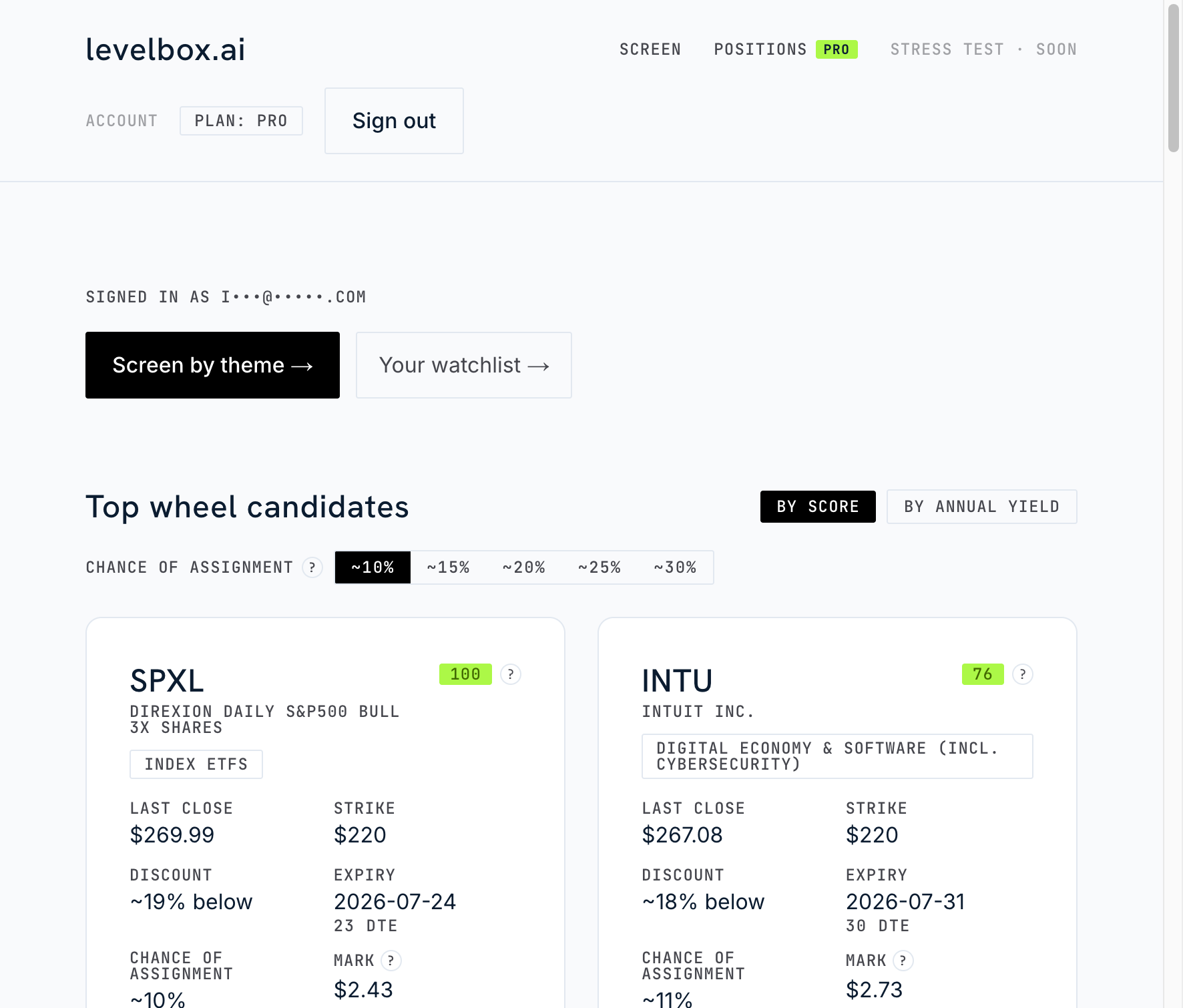
What we build
We build three kinds of software, and we have built one of each:
- Analytical products that turn market or business data into figures people act on. levelbox, an options screener for retail traders, is one.
- Client apps where your customers sign in and work with you. Groundwork, bluebed's strategy app, takes a client's brief, asks follow-up questions and returns the strategy in the app.
- Internal tools and rules engines that your staff rely on for a correct answer. bluebed's own Singapore property desk computes stamp duty and loan figures from 10 dated rule files. It is not public yet.
levelbox: a live product we built and run
levelbox.ai is a web app for retail traders who sell options on US shares. Its screener covers 399 stocks in 16 themes and shows the premium, annualised yield, breakeven, maximum loss and chance of assignment for each candidate. It holds no client money and places no orders.
Under the screen, a Python engine built on FastAPI does the analysis, and a Next.js web app serves desktop and phone. Supabase holds the database and user accounts. Scheduled GitHub Actions jobs collect SEC filings and option prices in the background, and an MCP server with 14 tools lets AI assistants such as Claude query it.
This is the shape of what we would deliver for you: a data pipeline, a tested calculation engine, an app your users open, and written rules on what the software may and may not say. The levelbox write-up covers the scoring, the market data and the build.
The checks under the screen
AI tools can now produce a good-looking screen in an afternoon, so a demo no longer shows whether software can be relied on. bluebed builds five checks underneath:
- Tests before every change. levelbox's Python engine has over 4,600 automated tests across 405 test files. A pre-push check runs them with the ruff linter and the mypy type checker, so a change that breaks a calculation does not reach the live site.
- Figures from code, not from a language model. levelbox computes every figure in its Python engine from market and SEC filing data. AI was used to build it, through Claude Code, but no language model writes the figures users see.
- Written rules. levelbox's rules sit in its CLAUDE.md file and apply to every coding agent and every change. They forbid fabricated data, require the risk to be shown beside every signal, and keep the wording educational rather than advice.
- Access tested by role. In Groundwork, colleagues see their own company's briefs, and the access rules are tested with three people: the owner, a colleague and a stranger. A stranger cannot open a brief.
- Sources with dates. Every rule in the property desk records its authority, its source URL, the date it took effect and the date it was last verified. A freshness check stops a figure being quoted to a client until stale rules are refreshed.
Our essay on what sits under the demo lists six questions to ask any vendor before you commission AI work.
How an engagement works
- First meeting. You describe the idea and what your team needs it to do.
- Research and scoping. We work out what is required: the data sources, the systems it must connect to, who will use it and what must be checked. A written quote follows.
- Build. We build it with AI, under written project rules and automated tests, as we did for levelbox.
- Review. Your team uses it before launch and tells us what is wrong or missing.
- Launch. It goes live to your users once your team has signed off the review.
- bluebed runs it. We keep the data jobs running, fix what breaks and keep improving it. Your team uses it from one app.
After launch, bluebed runs it
When a vendor hands over code and leaves, your team has to run software it did not write. With bluebed, the team that built the software keeps running it.
Running it means keeping the scheduled data jobs going, running the tests before every change, fixing what breaks and adding what your team asks for next. On levelbox, a scheduled job collects US insider trading filings every weekday, and the tests run before every change.
The quote covers running the software after launch as well as building it, so you see the full cost before you commit.
For founders without an engineering team
If you have a product idea but no engineers, bluebed can build the first version and run it. You can put it in front of customers before you hire a team.
Questions about AI software development
How much does AI software development cost in Singapore?
Every build is different, so a price set before we understand what you need would be a guess. The price depends on four things: the scope of what the software must do; the data sources and systems it connects to; how much must be checked or tested before it can be trusted; and running and monitoring it after launch. The first meeting and the research that follows establish what is required, and then we send a written quote.
How long does an AI software project take?
We do not give a duration before we know what is required, because it depends on the same things as the price. Every project goes through the same stages: a first meeting, research and scoping, the build, a review by your team, launch, and then bluebed running it.
Should we build custom software or buy an off-the-shelf tool?
Buy when an existing product already does the job with your data and your process. Build when the capability is specific to your business, depends on data or rules that no product holds, or is what sets you apart from competitors.
What happens after launch, and who runs the software?
bluebed runs it. We keep its data jobs running, run the tests before every change, fix what breaks and keep improving it, while your team uses it from one app. The team that built the software is the team that runs it, so nobody has to learn the code from scratch.
How do you control who can see our data?
In Groundwork, bluebed's client app, colleagues see only their own company's briefs, and the rules are tested with three people: the owner, a colleague and a stranger. A stranger cannot open a brief. If PDPA or MAS guidelines apply to your data, tell us at the first meeting so they are part of the scope and the quote.
How do you stop AI software giving wrong answers?
Figures come from tested code, not from a language model. In levelbox, the Python engine computes every figure from market and SEC filing data, over 4,600 automated tests run before any change ships, and the project's written rules forbid fabricated data. In Groundwork, facts are checked before a strategy is written, and an automated checker runs before anything reaches the client.
Can you show us software you built that is live?
Yes. levelbox.ai is live: an options screener for retail traders that bluebed built and runs. It covers 399 US stocks, has over 4,600 automated tests on its engine, and has an MCP server with 14 tools for AI assistants. It is analysis, not advice. The write-up is at bluebed.ai/insight/levelbox.
Do you work with companies in Malaysia?
Yes. bluebed is based in Singapore and takes on software projects for companies in Singapore and Malaysia.
We also make ads, drama and animation with AI, planned from research into the ads that run longest in your category. See AI video production.
Further reading
- AI makes the part a client sees cheap to produce, so check what sits under itAI tools make a screener page, a strategy deck or a clip in an afternoon; across four bluebed projects, the value is in the checks, sources and risk controls underneath.
- levelbox.ai: the options screener, and the risk, market and signal work under itlevelbox ranks cash-secured puts for retail traders; most of what bluebed built sits under the screener, in risk controls, a market backdrop read and signals of change.
Book a meeting
Tell us the idea in a few lines and pick a time. After the meeting and the research, we send a written quote.
Book a meeting