AI makes the part a client sees cheap to produce, so check what sits under it
AI tools make a screener page, a strategy deck or a clip in an afternoon; across four bluebed projects, the value is in the checks, sources and risk controls underneath.
The part a client sees is now cheap to make
Every bluebed project has a part the client sees: a screen, a strategy or a finished clip. AI tools can now generate a stock screener page, a strategy deck or a polished video clip in an afternoon, so a good-looking demo no longer tells a buyer whether the work behind it can be relied on.
A buyer should ask what sits under the demo: the checks that stop a wrong figure reaching a screen, the controls on risk, the source behind each claim, and the rules that keep output the same from one day to the next. This is what bluebed means by the tip of the iceberg: the visible part is small, and most of bluebed's work is the part underneath.
levelbox: an options screener with risk controls under it
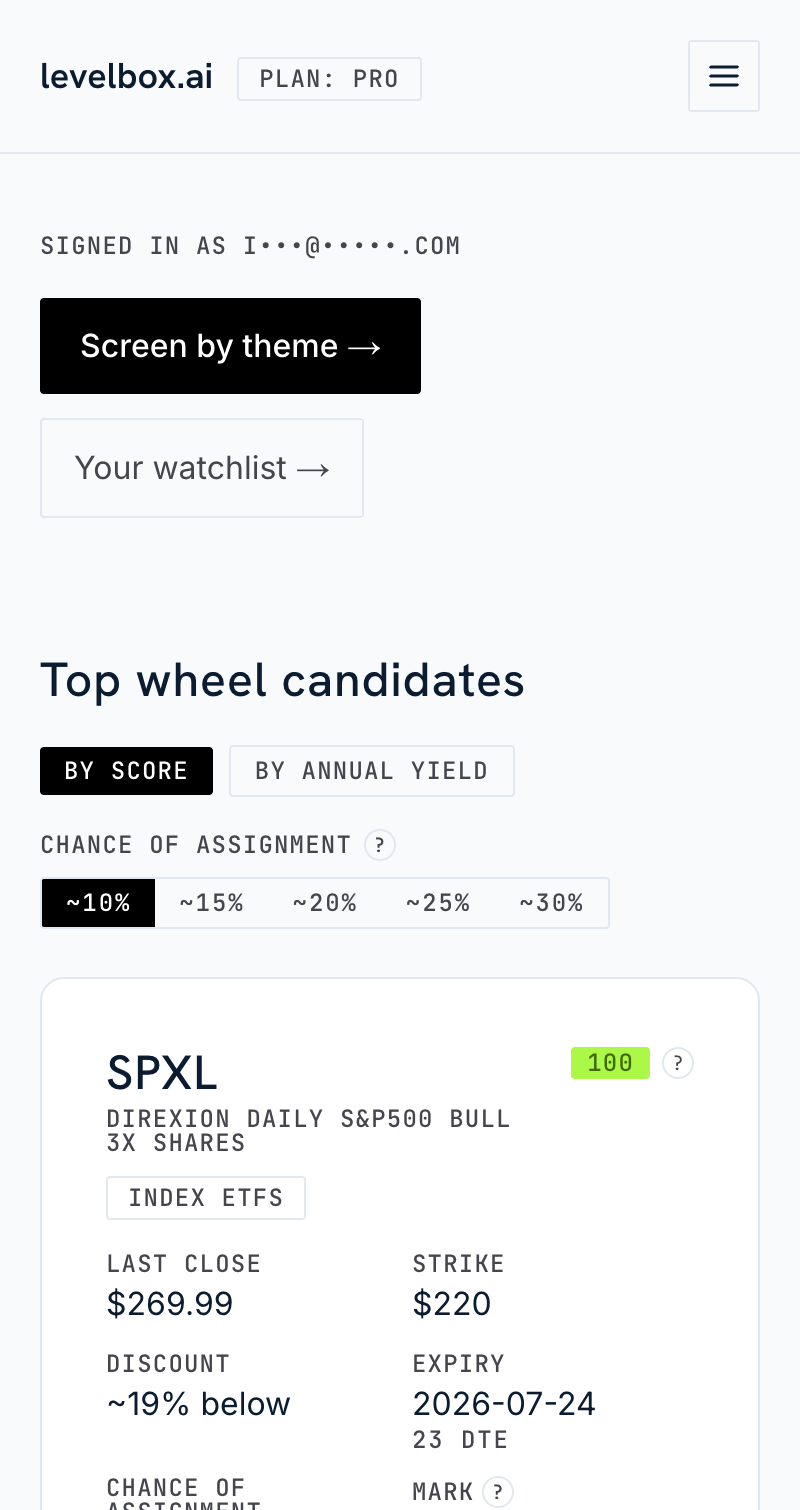
What users see. levelbox.ai ranks cash-secured puts and covered calls on US shares. For each candidate it shows the premium, annualised yield, breakeven, maximum loss and chance of assignment.
What sits under it.
- Over 4,600 automated tests on the Python engine. Before any change leaves a developer's machine, a pre-push check runs them with the ruff linter and the mypy type checker.
- A gate before scoring: a stock is ranked only if it is listed in the US, has listed options and passes a minimum financial standard.
- A list of 34 leveraged and inverse ETFs whose premium score is halved, so their large premiums do not carry them to the top of the list.
- Written project rules that forbid fabricated data, require the risk to be shown beside every signal, and keep the wording educational rather than advice.
- A market regime score from 0 to 100, and the quarterly 13F holdings of 17 superinvestor funds, each fund's SEC identifier checked against the SEC's EDGAR database.
What it means for a trader. The maximum loss sits on the same line as the premium, and a change that breaks a calculation is stopped by a test before it reaches the live site. The write-up levelbox.ai: the options screener, and the risk, market and signal work under it covers the scoring weights, the market regime inputs and how levelbox was built.
Groundwork: a strategy app with research and checks under it
What clients see. At bluebed.ai/start, a client writes a brief, answers a short round of tap-to-correct questions, and reads a strategy in the app.
What sits under it.
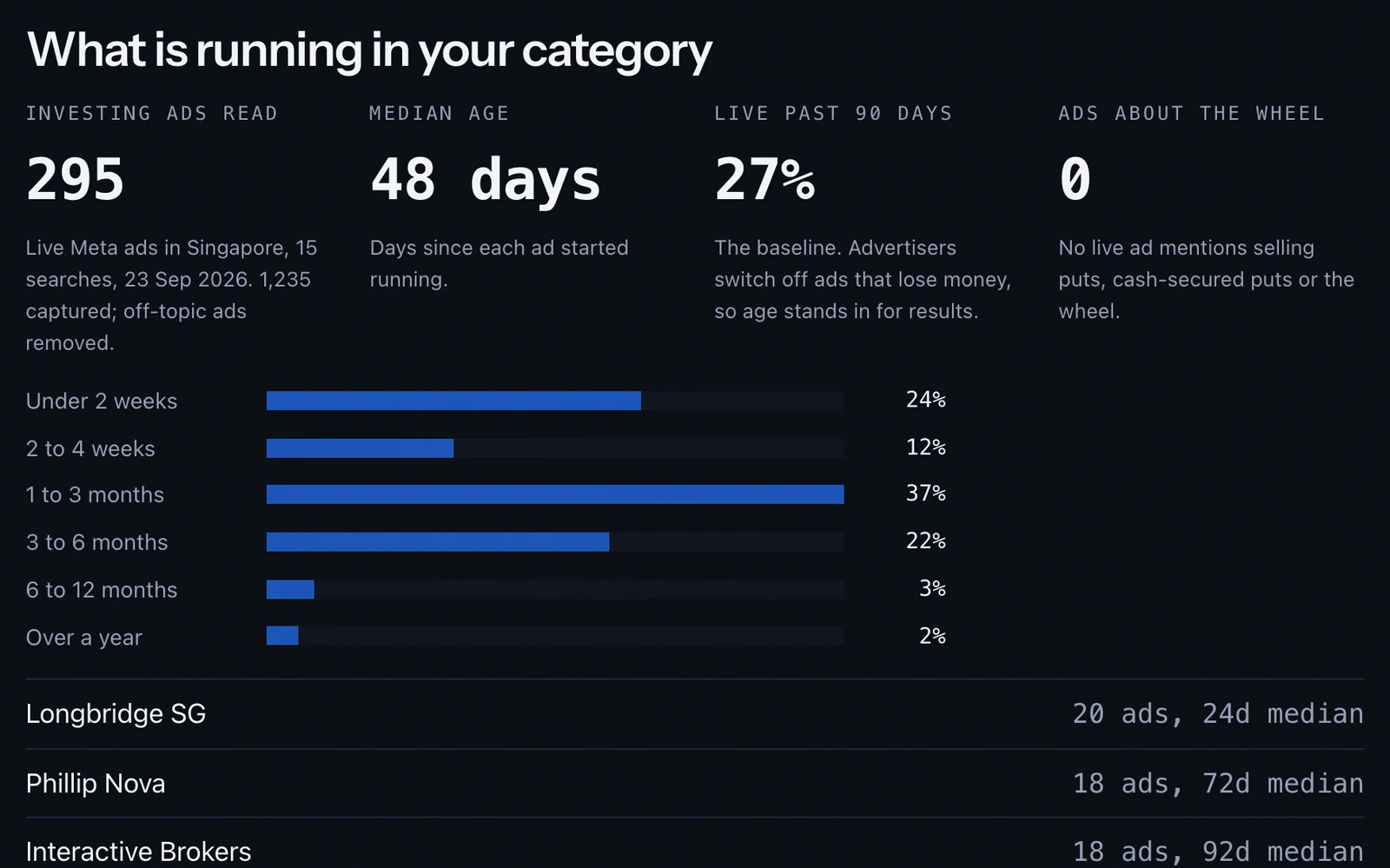
- Competitor ad research. Groundwork reads live ads in the client's category from the Meta Ad Library and records how long each has run. Nobody publishes results for commercial ads, so age stands in for performance: an ad still running after three months has passed a budget decision the advertiser keeps re-making. The sample research screen on this page read 295 live investing ads in Singapore across 15 searches on 23 September 2026; their median age was 48 days, and 27% had run past 90 days.
- A checked fact base. Facts are checked before any strategy is written, and every strategic option must cite checked facts and at least one cultural finding.
- An options engine. It writes several options, rejects any two that share how the buyer acts or why the buyer trusts, and checks every option against every item in the client's brief. An automated checker runs before anything reaches the client.
- A copy gate. Every sentence must pass a deletion test and say what it means for the reader.
- Access by company. Colleagues see their company's briefs, and the access rules are tested with three people: the owner, a colleague and a stranger.
What it means for a client. Each option in the strategy traces back to a checked fact, the options are different choices rather than one idea reworded, and a stranger cannot open the brief.
Studio: film and video with consistent characters under it
What audiences see. A finished clip.
What sits under it.
- A character bible for each production, covering cast, sets and props, each with a locked description. Each character also has an identity model, so the same face holds from shot to shot.
- One approved reference still per character, used as the anchor for every new shot. Background extras are packed as a set, so the same faces recur in the background.
- Shots planned before anything is generated, and takes chosen by eye.
What it means for a brand. A character looks the same in every shot of a series, and the take that ships was picked from several, not accepted as the first one generated.
Property desk: property duty and loan figures with dated rules under them
What a user would see. A stamp duty or loan figure. The property desk is bluebed's own Singapore property tooling and is not public yet.
What sits under it.
- A rules engine with 10 rule files: Buyer's Stamp Duty, Additional Buyer's Stamp Duty, Seller's Stamp Duty, Additional Conveyance Duties, lease duty, financing limits, HDB eligibility, progressive payment, primary school proximity and ownership structuring.
- Every rule records its authority, such as IRAS, its source URL, the date it took effect, and the date it was last verified against a primary source.
- Figures computed by tested scripts, never typed in by hand.
- A freshness check that warns when a rule has gone unverified. A session will not quote a figure to a client until the rules are refreshed.
- Guards against known errors. Seller's Stamp Duty, for example, is chosen by the date the property was bought, not today's date.
What it means for a buyer or seller. Each figure can be traced to a named authority and a verification date, and a rule that has changed since it was last checked is flagged before the figure is used.
Questions to ask before you commission AI work
Ask a vendor these six questions about the part under the demo:
- What checks run before a change reaches users, and how many automated tests are there?
- Where does each figure come from, and when was that source last verified?
- What stops the system from making up a number or a fact, and are those rules written down?
- How do you keep a face, a format or a tone the same across every output?
- Who else can see my data, and how has that access been tested?
- When a rule or a market changes, how does the system find out?
A vendor who has built the part underneath can answer each question with a mechanism and a count. If the answer to each is another demo, assume the part underneath is missing.
Talk to bluebed about your idea
bluebed is the launchbed for your blue ocean idea: a Singapore studio that builds the checks, sources and controls under the product your customers see. To discuss what your idea needs underneath, book a meeting.
Sources
- levelbox.ai write-up
- bluebed's account of the levelbox screener and the risk, market and signal work under it. — read 2026-10-20
- Meta Ad Library
- Live ads about investing in Singapore, read for Groundwork's sample research screen; 15 searches, 1,235 ads captured, 295 kept. — read 2026-09-23
- bluebed property rules engine
- 10 rule files covering Singapore stamp duties, lease duty, financing limits, HDB eligibility, progressive payment, school proximity and ownership structuring. — read 2026-10-20
Questions
Why is an AI demo not enough to judge an AI vendor?
AI tools can now generate a screener page, a strategy deck or a polished video clip in an afternoon, so a good-looking demo no longer shows whether the work can be relied on. A buyer should ask what sits under the demo: the tests, the source behind each figure, the risk controls and the rules that keep output consistent.
What questions should I ask before commissioning AI work?
Ask what checks run before a change reaches users and how many automated tests exist; where each figure comes from and when its source was last verified; what stops the system making up facts; how faces, formats and tone stay consistent; who can see your data and how that was tested; and how the system learns that a rule or market has changed.
What sits under the levelbox options screener?
Under the levelbox.ai screener, built by bluebed, sit over 4,600 automated tests run before every change ships, a gate that ranks only US-listed optionable stocks passing a financial floor, a halved premium score for 34 leveraged and inverse ETFs, and written rules against fabricated data and advice.
How does bluebed's Groundwork app research competitor ads?
Groundwork, bluebed's client strategy app, reads live ads in the client's category from the Meta Ad Library and records how long each has run. Because commercial ad results are not published, an ad still running after three months is treated as one the advertiser keeps paying for.
How does bluebed keep AI-generated characters consistent across a film?
Each bluebed Studio production has a character bible with locked descriptions of cast, sets and props, an identity model per character, and one approved reference still per character as the anchor. Shots are planned before generation, and takes are chosen by eye from several.
How does bluebed keep Singapore property figures current?
bluebed's property rules engine has 10 rule files, each recording its authority, source URL, effective date and last verification date. Figures are computed by tested scripts, and a freshness check stops a figure being quoted to a client until stale rules are refreshed.
If you want something like this made, book a consultation